

Digital Exclusion and Women in Sudan: When the Internet Becomes a Closed Door to Justice
by: Aunnab Alman
101 Days of Silence: When the Internet Becomes a Weapon of War
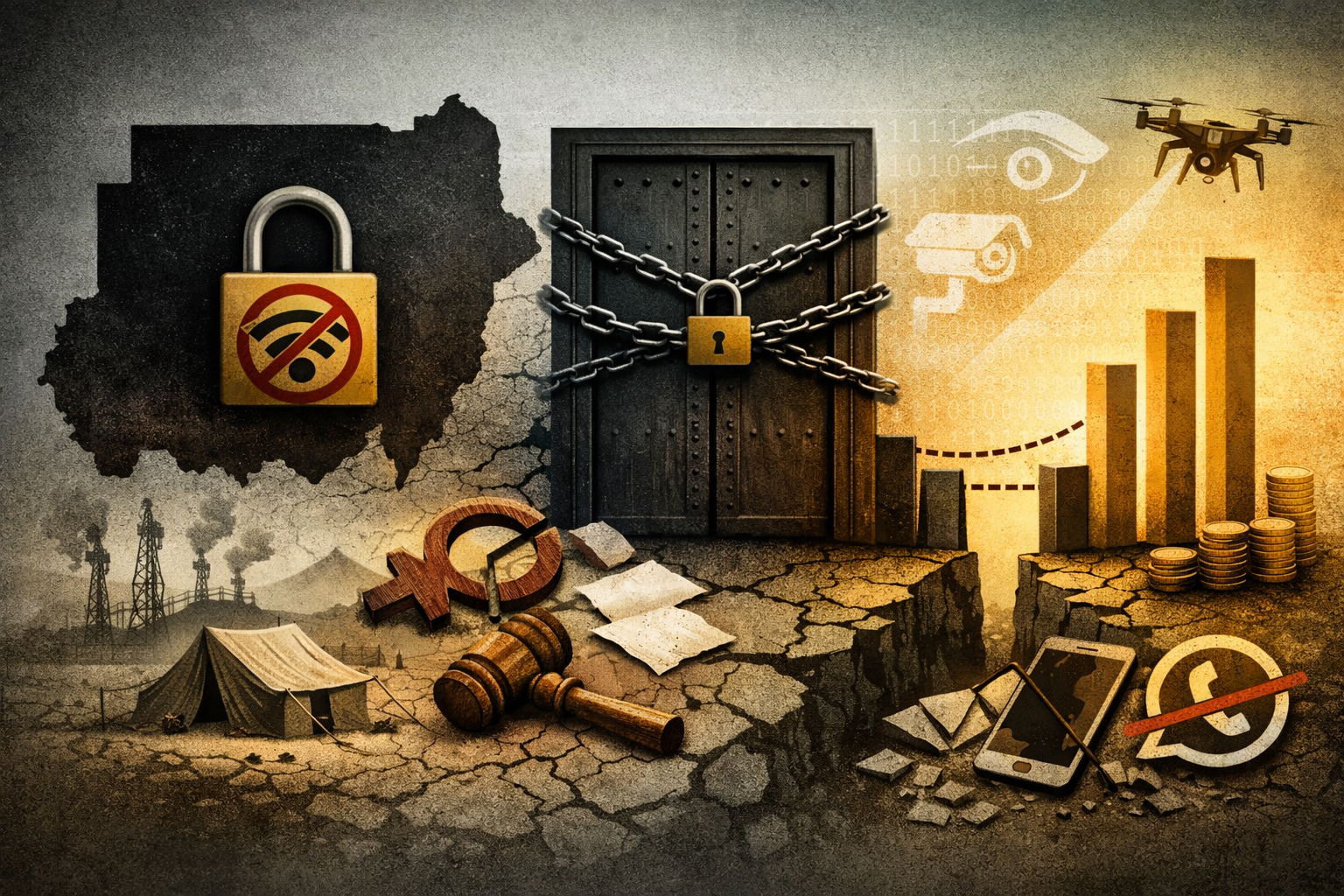
In February 2024, the internet in Sudan was cut off for 101 consecutive days. It was not a temporary technical glitch, but a complete blackout affecting more than 14 million people. For women who were and continue to be subjected to various forms of violence, and who needed to report this violence—which is inherently gender-based—or contact a lawyer, or understand their legal rights, those days—which continue to this day—were not merely a technical inconvenience, but a severing of a lifeline.
Since the war broke out in April 2023, internet outages have become a systematic weapon of war. Communications infrastructure has been targeted, seized, and deliberately cut off. In February 2024, Rapid Support Forces stormed telecommunications facilities in Khartoum and forced engineers at gunpoint to cut service. A blackout lasting 101 days followed WhatsApp—the most widely used app for legal consultations—was blocked. By November 2025, four major outages had been recorded in a single year. Each outage, each ban, cut Sudanese women across the country off from the legal information they desperately need.
Inas: A Woman in Darfur with No Internet and No Rights
Inas Salah is a displaced person in the Zamzam camp in Darfur. Her husband has been missing since the start of the war. She is alone with three children. She doesn’t know how to prove her husband’s disappearance. She doesn’t know she has a right to alimony. She doesn’t know there are courts or agencies that can help her. She has never heard of a women’s organization that provides legal support. Not because she doesn’t want to know. But because the internet in Darfur is completely cut off, and there is no channel connecting her to information.
The resistance committees in her camp use a Starlink device, but Ina is not part of these committees. She is an ordinary woman in a camp. No one comes to tell her about her rights. There are no messengers, no leaflets, and no volunteer lawyers reaching her. Legal information never reaches her. Not because it arrives late. But because it doesn’t arrive at all.
Inas does not know that she has any legal rights. She believes that what is happening to her is her fate. Inas is not just one woman, but her story tells us that she is one of millions of women in Darfur and Kordofan who have been deliberately cut off from the internet—and with it, cut off from awareness of their legal rights.
Rights on Paper Only: 44.4% Legal Protection
Although on paper, Sudan has made progress—the Public Order Act was repealed, female genital mutilation was criminalized, and women gained the right to pass on citizenship to their children—the data tells a different story. UN Women’s . This means that more than half of the legal protections women need are either absent or incomplete. The Personal Status Law still grants men legal authority over marriage and divorce, and domestic violence is not comprehensively criminalized. Even when laws exist, they remain out of reach for women who are unaware of them—or cannot afford a lawyer.
Closed Courts and a Paralyzed Judicial System
The war has made this reality even harsher. Courts have closed in most states, and legal information becomes useless without a functioning judicial system to enforce it. But what is most shocking is the lack of data: of the 31.2%. We do not know how many women own a smartphone, how many have regular internet access, or how many have been able to access legal information during the war. This is not a technical gap, but a failure to see the problem—blind spots that render women invisible.
Inas does not know that Sudanese law grants her the right to child support. She doesn’t know that there are courts that can hear her case regarding her missing husband. She doesn’t know that women’s organizations offer free legal counseling to women like her. Not because she is negligent. But because the internet in Darfur is cut off. Because no one comes to tell her. Because legal awareness itself has become a luxury available only to those who have a connection to the world. Inas is not a rare case. Inas is the norm. She is the woman who has fallen through every gap: the geographical gap, the technological gap, the awareness gap, the data gap. And she remains in her camp, waiting for information that may never arrive.
Before the War: Deep-Seated Social and Cultural Barriers
However, the problem runs deeper than mere disconnection. Before the war, women’s access to the internet was unequal. Research by the Association(APC) indicates that women faced direct social and cultural constraints: men’s control over phones within the household, monitoring of their digital activity, and fear of violence associated with internet use. In this context, the phone was not merely a tool, but a space subject to negotiation within a patriarchal structure; the war did not create this gap, but deepened it to the point of complete exclusion.
Darfur and Kordofan: Where Everything Collapsed
In western Sudan, across the entire Darfur region and large parts of the Kordofan region—where the Rapid Support Forces (RSF) have complete control—landline communication networks have collapsed almost entirely, and communication now relies on limited alternatives such as Starlink devices, which are used through intermediaries at a high cost. In this context, the internet is no longer a public service but a scarce resource distributed according to financial capacity and local connections. This shift does not isolate everyone equally but reproduces existing inequalities—most notably the inequality between men and women.
Digital Violence: A Compounding Obstacle
The risks become even more complex with digital violence. According to an APC report, women’s digital use in Sudan is linked to family surveillance and threats of physical or psychological violence when attempting to access the internet. Women who turn to female lawyers or women’s organizations may face double obstacles: violence associated with access, and physical and technical barriers. In areas controlled by the Rapid Support Forces, where families rely on the scarce Starlink service, women become more vulnerable to being denied legal services, and dependence on men as intermediaries for accessing information increases, deepening the power and dependency gap.
A Double Gap: Cost as an Additional Barrier
In addition to social constraints, cost poses a major barrier. Women who rely on limited income or humanitarian aid often lack the financial means to access the internet through alternative solutions, further exacerbating their digital exclusion. These factors combine to form a “double gap” during conflict: the loss of connectivity due to war, compounded by the structural constraints that already existed on women’s access to technology. Women who did not have independent access to begin with are the most affected by internet outages and the least able to communicate with support organizations.What we are witnessing today in Sudan, specifically in the Darfur and Kordofan regions, is a shift from “internet outages” to “unequal access.”
Given this reality, restoring internet access alone cannot be considered a sufficient solution. First: Immediately lift the ban on WhatsApp, as it is an indispensable lifeline. Second: Collect gender-disaggregated data on internet access—without knowing who is being excluded, interventions remain guesswork. Third: Provide low-tech alternatives in areas with complete outages, such as radio and voice messages. Fourth: Train women in digital safety to protect them from surveillance and technology-related violence. Fifth: Document men’s roles and attitudes, as they may be as much a part of the solution as they are a part of the problem.
Conclusion: The Question Awaiting an Answer
Inas is still in Zamzam camp. Her phone is silent. She doesn’t know she’s actually entitled to child support. She doesn’t know her missing husband’s absence can be legally documented. She doesn’t know there are women’s organizations offering free counseling. She is not negligent. She simply lives in Darfur, where the internet is completely cut off, and where no legal information reaches her. Inas is not a rare case. Inas is the face of digital exclusion in Sudan. She is the woman who has fallen between all the gaps: the geographical gap, the technological gap, the awareness gap. And she is still waiting. She doesn’t know what she’s waiting for. Because she doesn’t know there’s anything to wait for. The data tells us that 6 million women in Sudan have been affected by the internet blackout. But it doesn’t tell us how many of them, like Inas, don’t even know they have rights. This is the question the numbers don’t answer: How do we reach a woman who doesn’t know she needs access?
The available data paints a grim picture, but it also charts a path. The path begins with acknowledging that the internet in the context of war is not a luxury, but the sole gateway to legal information. The path continues by collecting missing data, providing alternatives when networks fail, and engaging communities in solutions that recognize the complexity of gender roles. The question is not whether Sudanese women need legal information. The question is: Are we prepared to provide it in ways that reach them, and with the protection they deserve, in a country where justice itself has become contingent on connectivity?
This WanaData story was supported by Code for Africa and the Digital Democracy Initiative as part of the Digitalise Youth Project, funded by the European Partnership for Democracy (EPD).
1.Code for Africa https://share.google/Sshfg7LjgQoda7ma
2.Digitalise Youth | European Partnership for Democracy https://share.google/EhAdPl5C5MIqCHJQ
3.The Digital Democracy Initiative https://share.google/jeuyxo3TPtmQiN5Po
4.EPD | European Partnership for Democracy https://share.google/16LtPgkjTb9Gej7kc

اترك تعليقاً